SearchShifter

What Is SearchShifter™

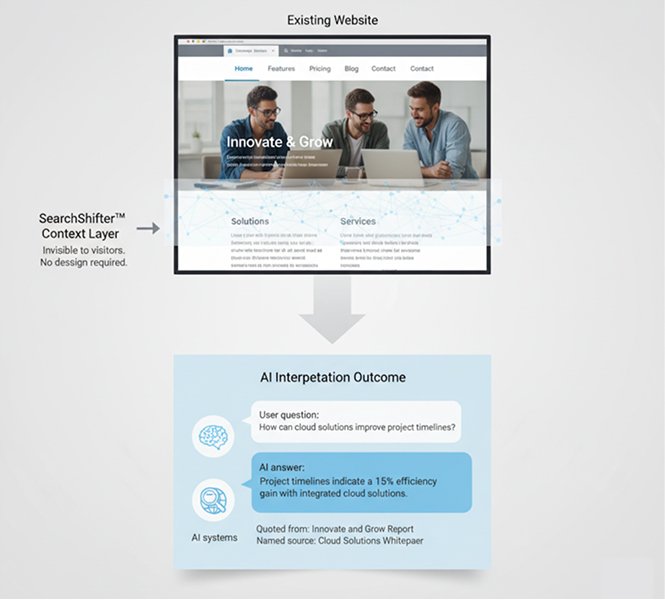
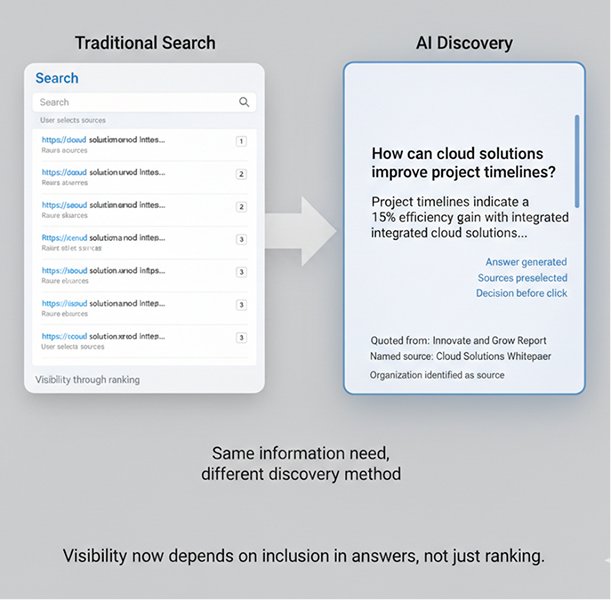
SearchShifter™ is a software layer that makes websites understandable to AI systems so they can be accurately quoted, summarized, and named in generated answers. Modern discovery increasingly happens through direct responses rather than lists of links. AI systems rely on clear definitions, consistent terminology, and explicit relationships to interpret information safely. Most websites were not built to provide this structure.

SearchShifter™ adds that structural clarity automatically, without redesign, content rewrites, or disruption to existing SEO work.

What SearchShifter™ Does

SearchShifter™ transforms a standard website into an AI-understandable knowledge source by automatically creating the structural context AI systems need to interpret content reliably without redesign. It produces:

To achieve the strongest results, organizations provide a small set of business-specific glossary terms and frequently asked questions that reflect their actual expertise. SearchShifter™ uses these inputs to establish clear definitions and context across the site automatically. Most agencies already have this information in proposals, onboarding materials, sales conversations, or support resources. Guidance on preparing these inputs is available in Documentation , and key terminology is explained in the Glossary.

Why It Is Necessary

Traditional optimization determines whether pages can be found. AI-driven discovery determines whether information is selected, quoted, and attributed when answers are generated.

A site can rank highly yet still be excluded from responses if its content is difficult to interpret consistently. When this happens, expertise may be overlooked or used without clear attribution.

SearchShifter™ addresses this gap by making site meaning explicit and coherent at the level AI systems require, increasing the likelihood that the organization’s information will be included, accurately quoted, and named as a source in generated answers.

How It Fits Into Existing Sites

Existing SEO, analytics, and marketing systems remain intact.

No Site Redesign
No Platform Changes
No Content Rewrites
No New Workflows
No Ongoing Manual Maintenance

SearchShifter™ installs on an existing website and operates automatically across pages. Implementation details and technical requirements are documented on Documentation Page.

What SearchShifter™ Changes

SearchShifter™ changes how a website communicates meaning to AI systems, not how it appears to human visitors.

After installation, the site presents a coherent knowledge structure rather than a collection of isolated pages. Concepts are defined explicitly, terminology becomes consistent, and relationships between topics are clear across the site. This allows AI systems to interpret the organization’s expertise reliably instead of inferring meaning from fragmented content.

The visible design, navigation, and user experience remain largely unchanged. Existing SEO performance, analytics, and marketing systems continue to operate as before.


Impact on Your Website After Installation

AI systems can understand your site the way a knowledgeable person would.

Important terms are defined, language is consistent across pages, and related topics are clearly connected. This helps ensure your expertise is represented accurately when AI systems generate answers.

Visitors see the same website.

What SearchShifter™ Is Not

SearchShifter™ complements existing tools rather than replacing them.

It provides the structural clarity required for AI interpretation.

A content generator

A ranking or SEO tool

A chatbot or AI assistant

A website redesign or replatforming solution

A replacement for existing SEO strategies

Evaluation Path

A free version is available for immediate installation on a live site. Pricing tiers and capabilities are described on the Pricing page.   

This allows organizations to evaluate how clearly their content can be interpreted by AI systems before committing to expanded capabilities.

Next Steps

To understand the step-by-step transformation process, see How It Works

For implementation details and configuration guidance, see Documentation

For use cases and fit, see Who Is It For

For terminology used across this site, see the Glossary

To compare plans or begin evaluation, see Pricing