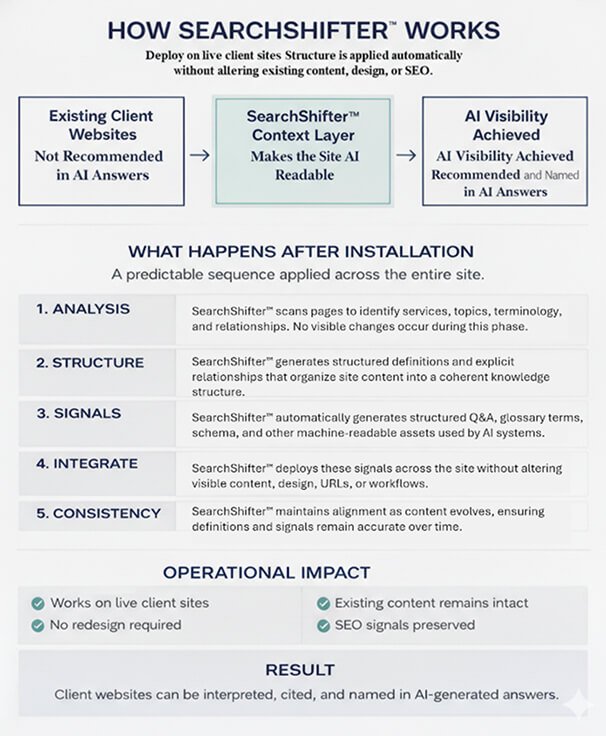
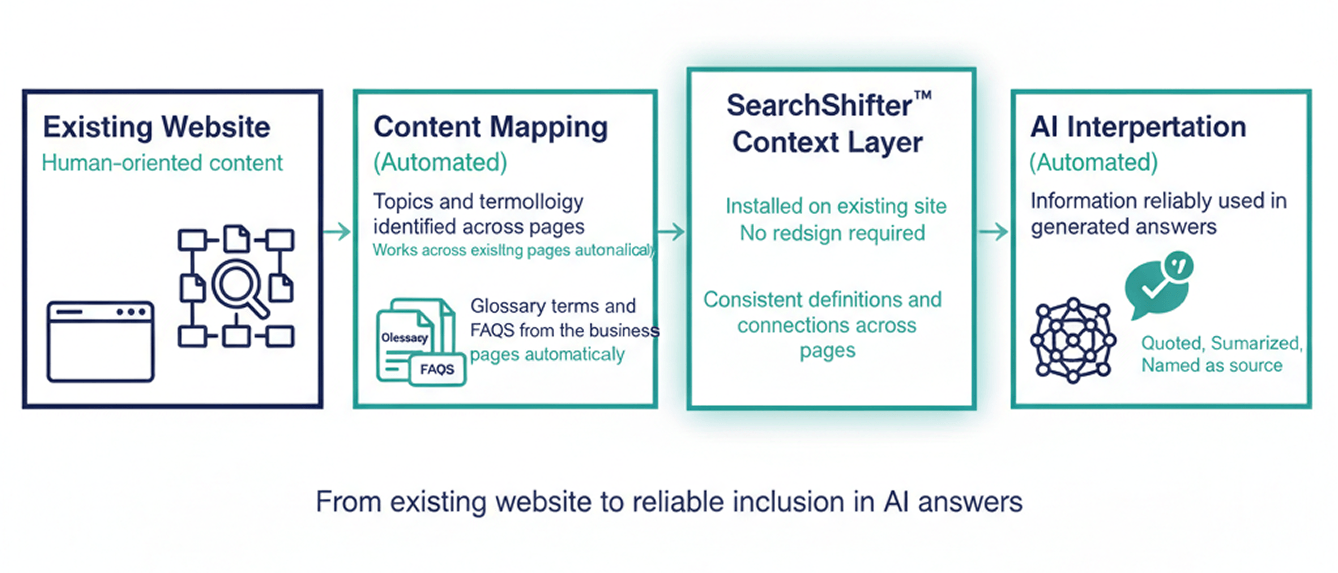
SearchShifter™ installs on an existing website and operates as an automated context layer that makes the site easier for AI systems to interpret.It analyzes pages to identify services, topics, terminology, and relationships, then applies structured definitions, connections, and machine-readable signals across the site.
The result is a coherent body of information that AI systems can interpret more reliably when generating summaries, comparisons, or recommendations.
SearchShifter™ installs on an existing website and immediately begins analyzing content across pages.
The system identifies key topics, recurring terminology, implicit relationships, and areas where meaning may be unclear or inconsistent from a machine perspective. This reflects how AI systems process pages individually rather than navigating a site the way people do.
No manual restructuring is required. Existing SEO performance, analytics, and marketing systems continue to operate as before. Technical requirements, configuration details, and deployment guidance are documented in Documentation
To produce the strongest results, organizations provide a focused set of glossary terms and frequently asked questions specific to the client’s business, services, and areas of expertise
These inputs define how the organization describes what it does, the problems it solves, the services it offers, and the terminology customers encounter when evaluating those services. They should reflect real client conversations and decision criteria rather than generic industry definitions.
Typical glossary terms include core services, proprietary methods, product names, industry concepts, and decision-related terminology relevant to the client’s offerings.
Most agencies already have this information in proposals, onboarding materials, service descriptions, knowledge bases, or support documentation
SearchShifter™ uses these inputs as authoritative anchors to align terminology and context across the entire site automatically. This ensures AI systems encounter consistent definitions and explanations rather than fragmented or inconsistent descriptions. Terminology standards used across the site are maintained in the Glossary

Using the analyzed content and defined concepts, SearchShifter™ builds a unified structural layer that connects related topics across pages.
Terminology becomes consistent, relationships are explicit, and explanatory context is reinforced throughout the site. Information that previously existed as separate documents becomes part of an integrated knowledge structure.
The visible design, navigation, and content remain the same. The improvement occurs in how meaning is organized and communicated beneath the surface.
SearchShifter™ produces standardized signals that clarify what each concept represents and how information should be understood within the broader context of the site. These signals allow AI systems to interpret meaning directly rather than guessing intent from isolated passages. Clear definitions and explicit relationships reduce ambiguity and increase confidence in how the information can be used.
When site meaning is explicit and consistent, AI systems can incorporate the organization’s information into generated responses more reliably.
This increases the likelihood that expertise will be represented accurately, quoted appropriately, and associated with the correct source when answers are produced. Organizations evaluating
suitability across industries can review common use cases on the Who It Is for page
SearchShifter™ is designed for low-friction deployment across one site or many. It does not require:
Existing SEO, analytics, and marketing systems remain intact. The system operates as infrastructure rather than a visible feature. Implementation scope and technical considerations are detailed on the documentation page
Site redesign or replatforming
Content rewrites
Ongoing manual maintenance
New production workflows
Pricing tiers and capabilities are described on the Pricing page. A free version can be installed on a live site, allowing organizations to evaluate how clearly their content can be interpreted by AI systems before expanding capabilities.
Implementation can be performed independently or integrated into existing agency processes, depending on operational preference. Plan options, feature differences, and upgrade paths are outlined on the Pricing
For technical configuration details and setup guidance, see Documentation
For terminology used across this site, see the Glossary
For use cases and deployment fit, see Who is it for
To compare plans or begin evaluation, see Pricing